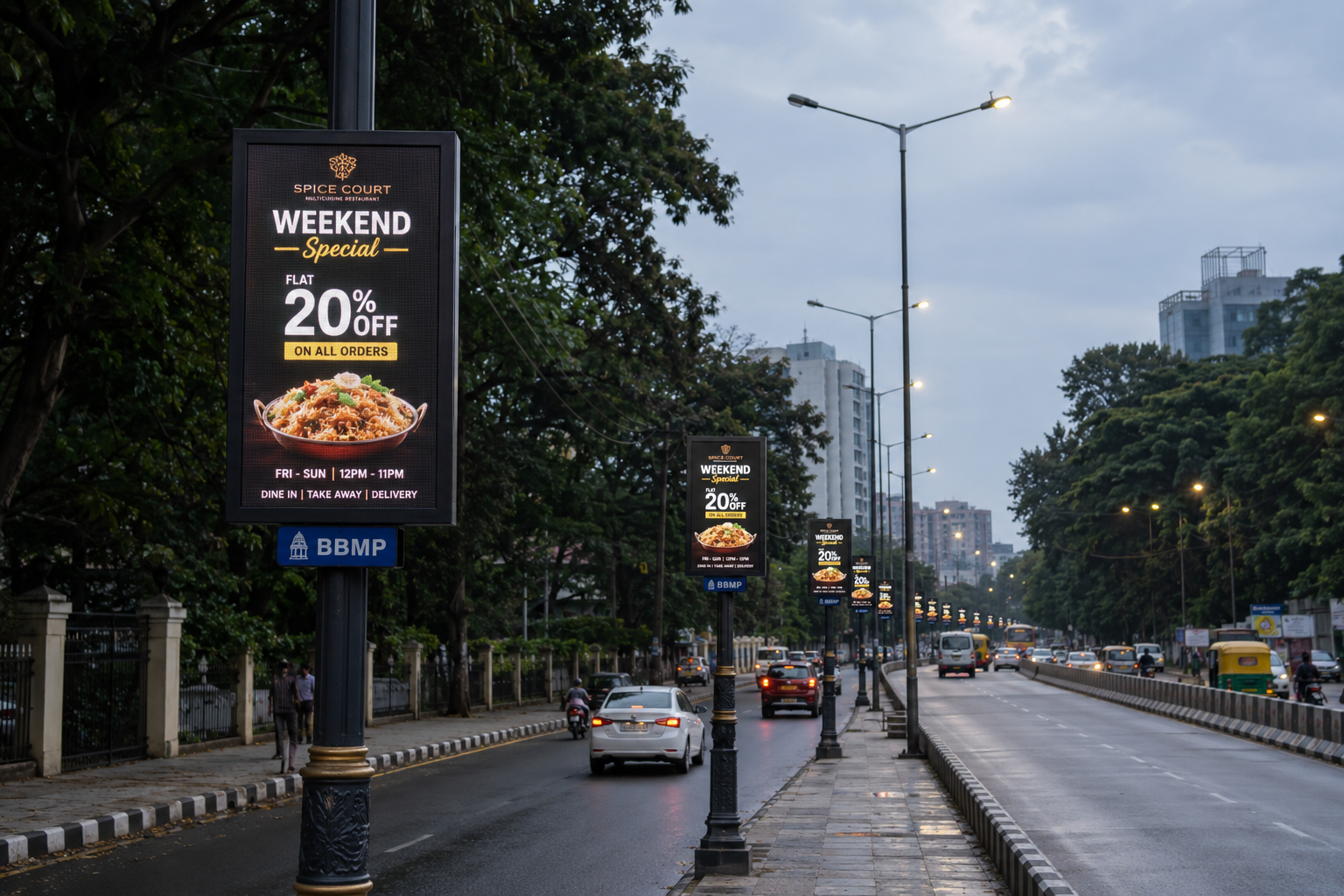
Ban the Flex.
Light Up Bangalore.
"This is what it looks like today. What if it didn't have to be?"
"This is what it looks like today. What if it didn't have to be?"
Walk down any major road in Bangalore. Every lamp post, every signal pole, every junction — wrapped in flex banners. Politicians smiling for elections that ended two years ago. Birthday wishes that were never taken down. Festival greetings from three seasons back.
Bangalore generates tonnes of non-recyclable flex banner waste every year. This plastic is not recyclable. It doesn't biodegrade. It falls into drains during rain, clogs them, and contributes to the flooding that paralyzes the city every monsoon. It blocks sightlines at junctions, creating road safety hazards. And it makes our city look like it's permanently in election mode.
"Only politicians and wealthy businesses can afford to speak in public space. Everyone else is invisible."
The current system is broken in another way too — it's deeply unequal. A politician can plaster their face across 500 lamp posts for a birthday celebration. A local restaurant trying to announce a new menu cannot afford the same reach. A citizen who wants to announce their mother's 80th birthday has no option at all. Public space belongs to everyone — but right now it only serves those with money and power.
Complete ban on flex banners across Bangalore. Every existing lamp post gets a weatherproof LED display panel — no new infrastructure, no new poles, no new wiring. The panels are managed by a private operator through a simple app. Anyone can book a slot. From ₹100 per pole per day.
Politician, local restaurant, grandmother announcing her daughter's wedding, school announcing admissions — same platform, same price, same access. Public space becomes genuinely public for the first time.
All new flex banners prohibited from a set date. Existing banners given 30 days to be removed. This is a policy decision — no technology needed at this stage.
Weatherproof panels installed on lamp posts across the city — using existing poles and power infrastructure. The operator funds the installation in exchange for a revenue share agreement with BBMP.
Choose location, choose duration, upload your content, pay online. Content goes through basic auto-moderation — no hate speech, no obscenity. Everything else is permitted.
During floods, public health emergencies, or civic announcements — BBMP can override all displays instantly. The poles become a city-wide communication network at zero additional cost.
The system is self-funding from day one. BBMP earns revenue from public infrastructure without spending a rupee on installation or maintenance.
| Factor | Flex Banner Today | LED Display |
|---|---|---|
| Environmental impact | Non-recyclable plastic, clogs drains | Zero waste, reusable indefinitely |
| Who can access it | Politicians + wealthy businesses only | Anyone — from ₹100/day |
| Road safety | Blocks sightlines, falls in wind | No physical hazard |
| Revenue for BBMP | Zero | Revenue share from day one |
| Civic communication | Not possible | Emergency broadcasts instantly |
| City aesthetics | Visual chaos | Clean, ordered, modern |
Bangalore instantly looks cleaner — visible to every resident within 24 hours
Tonnes of flex waste eliminated from landfill every year
Drain clogging from fallen flex reduces — less monsoon flooding
Any citizen can now speak in public space for ₹100
BBMP earns new revenue from existing infrastructure
City gets an instant civic communication network for emergencies
Strict but religiously neutral rules on public displays. Digital boards managed centrally. The city is visually clean while still allowing public communication.
Greater Hyderabad Municipal Corporation has begun regulating hoardings and moving toward digital displays in several zones. Early proof of concept in an Indian city.
Chennai has attempted flex bans multiple times with partial success. The missing piece every time was a viable alternative — which this provides.
Several Mumbai zones have moved to regulated digital displays. The democratized booking model — where any citizen can book — is the innovation nobody has implemented yet.
These are ideas, not answers. The best version of any idea comes from debate. Watch the reel, share your thoughts in the comments, or visit the site for more detail.